John Lennon — voice of a generation

“I never needed anybody’s help in any way.”
“We [The Beatles] are more popular than Jesus now.”
”War is over if
you want it.”
John Lennon
John Lennon wrote pop songs with Paul McCartney in the 1960s and 70s, and performed them with The Beatles. I was eleven when they first made it to the top of the music charts, and each song they released thereafter became a milestone of my adolescence — in fact, of my entire generation’s.
Still, I didn’t know whether to like them at first. Back in 1963 one was supposed to choose between The Beatles and The Rolling Stones. The Beatles had sweet voices and shining faces; The Stones were bad and ugly. At first the prettiness made me hesitate, but in time it was The Beatles’ ability to cast dreams that won me over (listen to Eleanor Rigby); it was more than just rock and roll.
I liked The Stones too, but it turned out that John Lennon’s loveable cheekiness hid a more complex and thoughtful bad boy than any of The Stones. That’s what I identified with.
One of Lennon's more thoughtful moments led to his statement (left) comparing the popularity of the Beatles with that of Jesus Christ. It was printed in an English newspaper, where it caused barely a ripple. Picked up in the United States, however, it provoked mass burnings of Beatles recordings and a campaign characterizing Lennon as the Antichrist — even Satan himself. Logically, his statement held water; emotionally, it was a time bomb that exploded when he wasn't even looking. My awkward adolescent self identified with this all too easily.
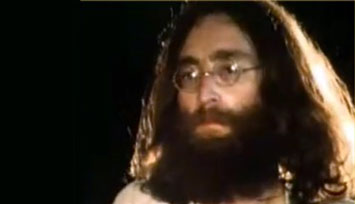
Would you introduce your daughter to this man?
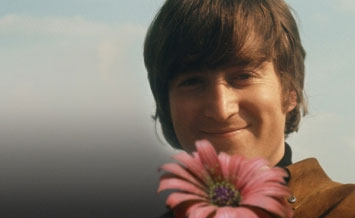
John Lennon, c 1965
sweet, shining face
After marrying Yoko Ono, leaving the Beatles and moving to New York in 1971, Lennon became more deliberately troublesome than ever, now as an anti-war activist. He returned the MBE (Member of the British Empire medal), awarded by Buckingham Palace in 1965, to protest Britain's support for US policy in Vietnam and its involvement in what he called ‘the Nigeria-Biafra thing.’ Years later he was quoted as saying: “Lots of people who complained about us getting the MBE received theirs for heroism in the war. They got them for killing people. We deserved ours for not killing people. In a way it was hypocritical of me to accept it.”
Lennon was a populariser of marijuana and LSD, and of the spiritual pilgrimage to India. More lastingly, he became a pro-love and anti-war icon, for which he was widely hated. When he was finally gunned down in New York City in 1980, the shooter turned out to be one of his fans, who just wanted to share in the glory of his fame.
I often wonder what sort of Music John Lennon would be making today, and what sort of things he’d be saying. He was never one to hold his tongue just because he had an impolitic thought. We need voices like that.
Read more about the transformational mood of the 1960s and John Lennon‘s influence in Stephen Schettini‘s The Novice.